We saw how using quantities per unit—density in this case, meaning mass divided by unit volume—allows us to leap from the physical realm into the geometric one.
This time, we’ll talk about quantities per unit in general and explore the essence of this approach: why, here and there, humans have continually introduced various quantities per unit and what benefits this provided.
One of the first quantities per unit we encounter when studying physics is speed.
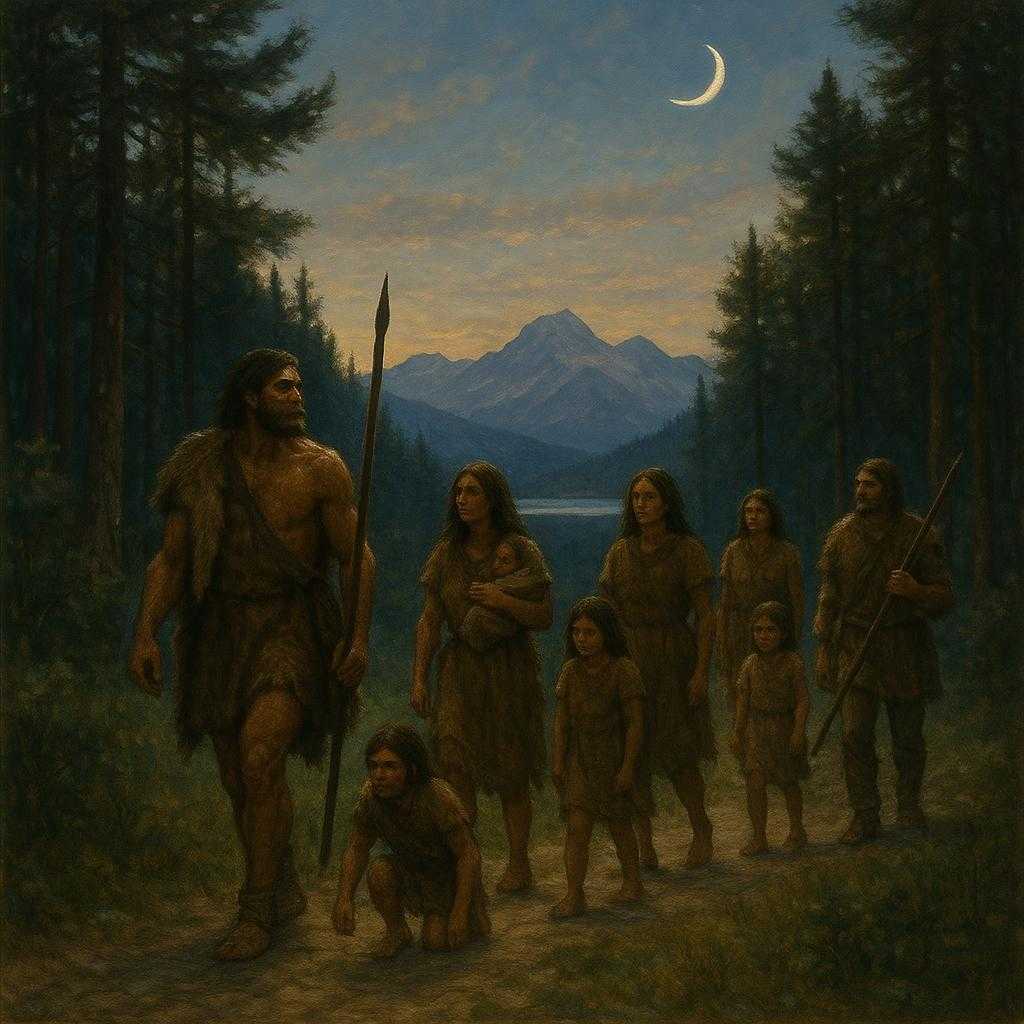
Let’s imagine people at the dawn of humanity. Humans were originally hunters—they constantly had to cover distances. While exploring the areas around their camps, people inevitably memorized the locations of various objects in the world around them. That mountain over there is a day’s journey away. And that lake visible from this hill is three days away. From a height, objects only seem within reach.
So, initially, it was enough for humans to operate in terms of time. The sun, with its sunrises and sunsets, was humanity’s primary timer. Nightfall meant it was time to make camp because traveling in the dark was dangerous—wild animals could eat you. Morning came—time to set out again. The lake is a three-day journey, so you need to plan your route in advance.
When you travel alone, measuring distances in terms of time is sufficient. But then hard times come (prey becomes scarce), and the whole family must pack their bags and set out. How long will it take to reach that mountain over there? Now you must base your estimate on the slowest member.
Now, measuring distances solely by time is no longer enough—it would be good to know distances as distances: at least in steps, but preferably in meters or kilometers, because steps can also vary in length.
But how do you calculate the distance if no ruler or rope (for measuring) is long enough to lay along the entire path from the camp to the mountain?
There’s only one way left: calculate the distance you can cover per unit of time, then multiply that number by the travel time (which must be expressed in the same units of time).
The distance a person covers in a short time is easy to measure—a ruler is perfectly sufficient for this task. And the sun or stars can help calculate the travel time. Now you know how far that mountain is from your camp.
Therefore, by taking the youngest member of your tribe and measuring their speed, you can easily calculate how long it will take for your entire group to reach that mountain.
This is how speed allowed us to measure what cannot be measured with ordinary tools.
To be more precise, it was mathematics—with its division and multiplication—that made this possible.
One important human skill is the ability to foresee, calculate in advance, and make plans that come true.
It all started with a simple trip to the mountains and ended with landing a rover on the Moon—where mathematics and physics helped humanity perfectly calculate the entire flight path of a space rocket across more than 300,000 kilometers.
Food for Thought
When you travel alone, measuring distances using time is sufficient.
Explain why.
Show answer
Because at a constant speed, distance is linearly dependent on time. From the formula , it’s clear that if the speed is constant, then the distance is determined solely by the time .
The more time, the greater the distance. Therefore, knowing only the travel time allows one to accurately judge the distance covered.
In mathematical terms, distance is a function of time— depends on .