But density isn’t just useful for finding the mass of an object that’s difficult to weigh, provided we know its volume.
It also allows us to verify if an object is truly made of the substance we think it is.
The Story in Pictures
The Story in Words
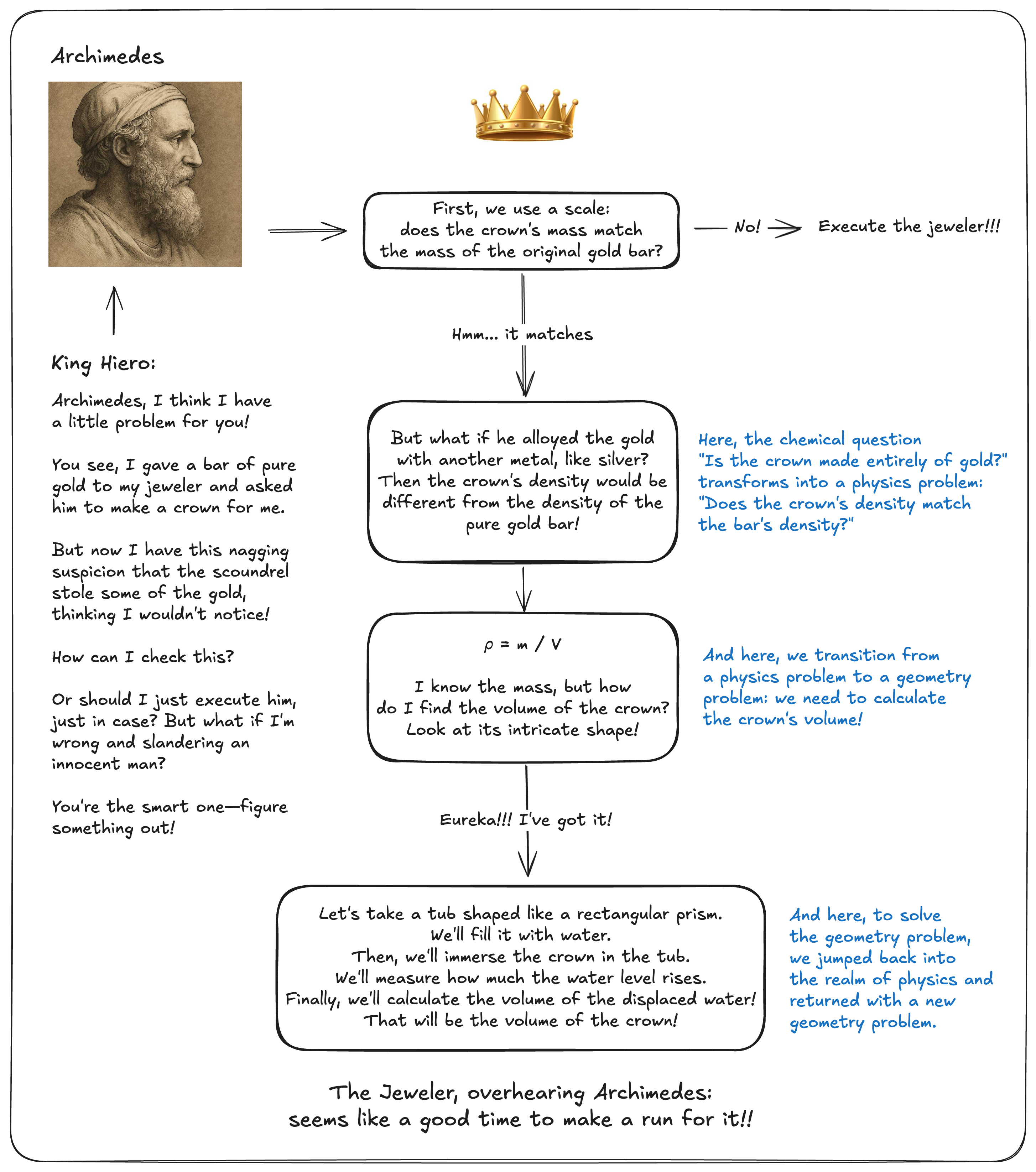
King Hiero:
Archimedes, I think I have a little problem for you!
You see, I gave a bar of pure gold to my jeweler and asked him to make a crown for me.
But now I have this nagging suspicion that the scoundrel stole some of the gold, thinking I wouldn’t notice!
How can I check this?
Or should I just execute him, just in case? But what if I’m wrong and slandering an innocent man?
You’re the smart one—figure something out!
Archimedes:
First, we use a scale: does the crown’s mass match the mass of the original gold bar?
If not? — Execute the jeweler!!!
Hmm… it matches.
But what if he alloyed the gold with another metal, like silver? Then the crown’s density would be different from the density of the pure gold bar!
(Here, the chemical question “Is the crown made entirely of gold?” transforms into a physics problem: “Does the crown’s density match the bar’s density?”)
I know the mass, but how do I find the volume of the crown? Look at its intricate shape!
(And here, we transition from a physics problem to a geometry problem: we need to calculate the crown’s volume!)
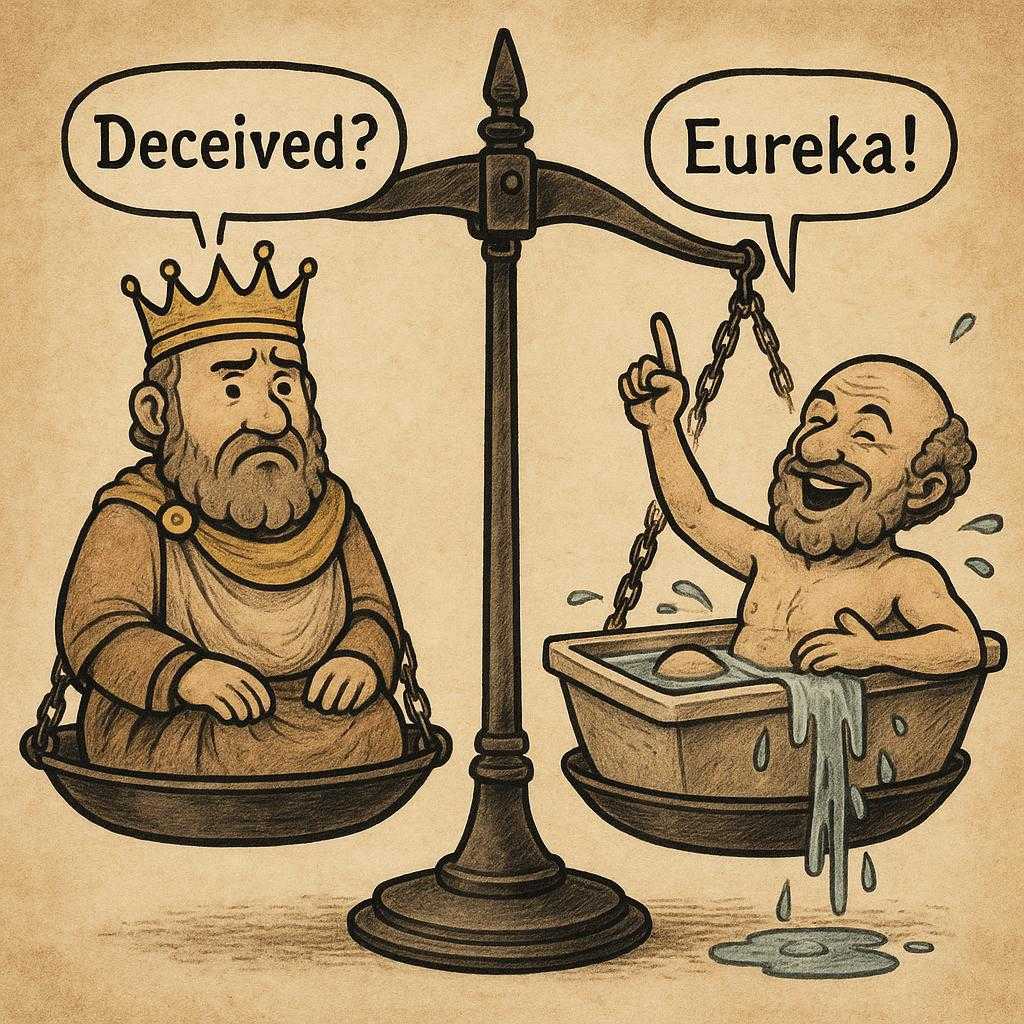
Eureka!!! I’ve got it!
-
Let’s take a tub shaped like a rectangular prism.
-
We’ll fill it with water.
-
Then, we’ll immerse the crown in the tub.
-
We’ll measure how much the water level rises.
-
Finally, we’ll calculate the volume of the displaced water!
-
That will be the volume of the crown!
(And here, to solve the geometry problem, we jumped back into the realm of physics and returned with a new geometry problem.)
The Jeweler, overhearing Archimedes:
Seems like a good time to make a run for it!!
The Technical Details
To calculate the volume of the displaced water, you multiply the base area of the tub by the change in water level:
where is the area of the tub’s base, and is the height the water level rose.
Food for Thought
What if the tub weren’t rectangular, but cylindrical? How would we calculate the volume then?
Show answer
We would still use , but in the case of a cylindrical tub, would be the area of the circular base. That is:
where is the radius of the base (the circle), and is the number Pi.