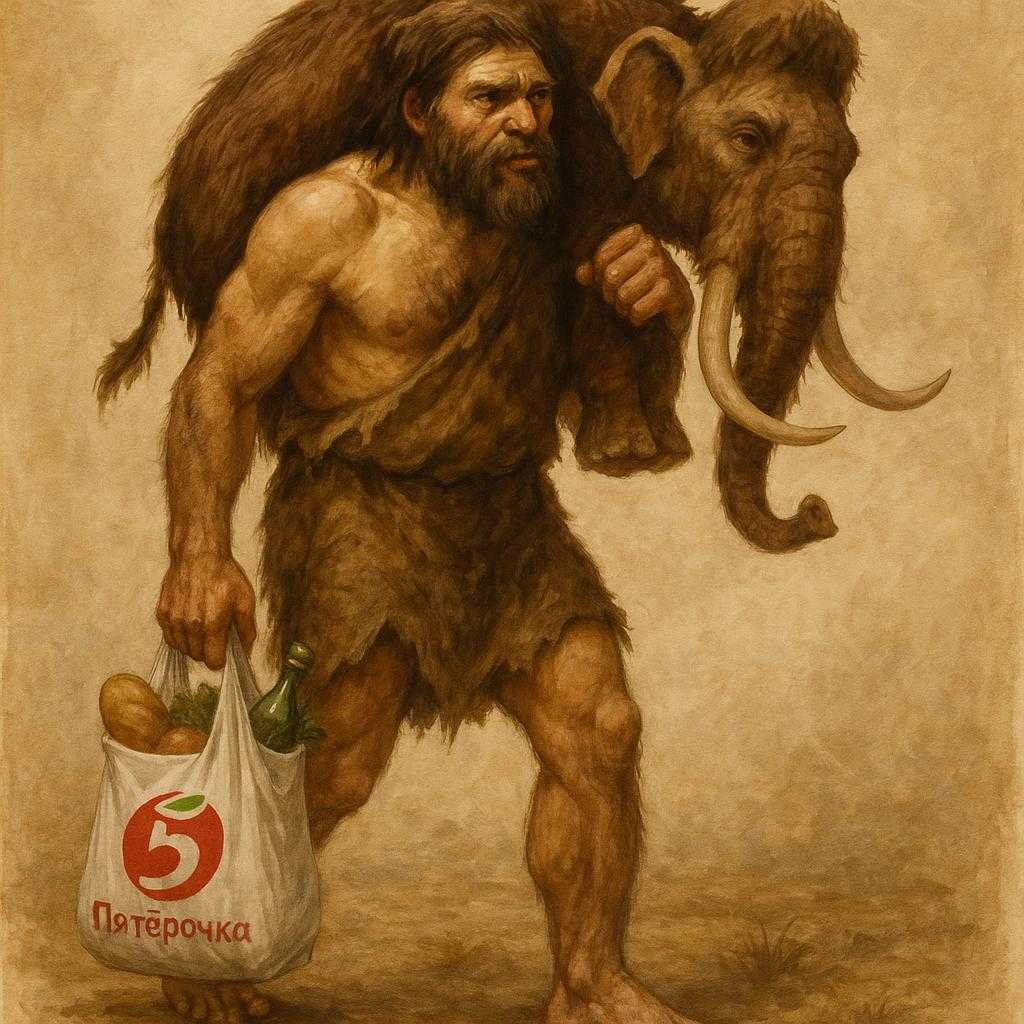
We’ve discussed how a situation might arise where you’re sent to the store to bring back a ton of cement, and you couldn’t do it for obvious reasons: you need a loader, a vehicle for transport, then a cart, or you’d have to carry the cement in parts—if you’re even physically capable of lifting at least one bag. (When we say “couldn’t,” we mean “within the framework of the shopping algorithm we wrote,” as it didn’t account for all these additional actions).
But that’s not the point right now. Let’s focus on one small detail: the necessity of carrying things has pursued humanity since the very beginning of its existence.
First, people had to carry mammoth carcasses, then some stones to arrange their dwellings, then sacks of grain, and today we carry grocery bags from the store or cement during renovations (or hire special people for this).
So, since ancient times, people have encountered the concept of mass (of objects), and at some point, they needed to measure it somehow, compare it with other objects, and understand their capabilities (like: I can lift a maximum of 50 kg, and if a piece of mammoth weighs more, I’ll strain myself).
The simplest method a person invented to weigh an object is the equal-arm balance.
We came to the playground and decided to weigh all the children, but we don’t have weights. However, we have the skinniest kid, Peter, and we decided to measure everyone in “Peters.” We sit Peter on the seesaw, and on the opposite side, we sit John. Whoever outweighs the other is heavier.
Greeeat! But what if we need to know exactly how much John weighs? Well, he weighs more than Peter, but by how much or how many times more? Does he weigh like 2 Peters or 1.5 Peters? We can’t divide John into parts—so what should we do?
And here we can apply physics: use a lever!
In real life, children instinctively know that if one is too heavy compared to the other on a seesaw, the heavier one needs to move closer to the fulcrum (the axis around which the board pivots), while the lighter one needs to sit as far out as possible—closer to the edge. So both move: one towards the center, the other towards the edge, until they balance each other.
That is, a lever, first and foremost, allows the weaker to handle heavier things (Johns). It provides a mechanical advantage in force.
But we are talking about mass right now. So, Peter and John are sitting on the seesaw, and it’s completely balanced. However, we know that John weighs more than Peter, but by how much or how many times more?
And here physics tells us: John weighs more than Peter by the same factor as the distance from Peter to the center of the seesaw (i.e., the fulcrum) is greater than the distance from John to that same center!
This is how the problem of weighing transitions from the physical plane to a purely geometrical one.
For example, we don’t have a scale, but we have a ruler, and by measuring these distances and dividing one by the other, we can determine how many times heavier John is than Peter.
Humans learned to measure distances in ancient times: first using their own body parts (for example, the length of a palm), and later by creating standardized distance units.
Therefore, by translating a physics problem into a geometry problem, we simplify its solution.
And this is just the first example of how physics interfaces with geometry.
Next, we will talk about density: what it is, why it was introduced, and how it represents another similar leap from physics to geometry.